1

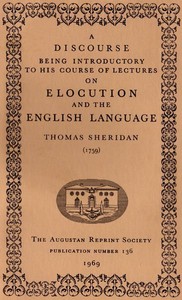
A Discourse Being Introductory to his Course of Lectures on Elocution and the English Language (1759) — Context and Discussion
140
2
Project Gutenberg
2011
Elocution -- Study and teaching -- Early works to 1800
Readers of public-domain and historical texts
Project Gutenberg digital edition
en
Edition facts
Words: 19,157
Reading time: 84 min
Text sections: 3
Source:
Project Gutenberg record #38444
Sheridan's 1759 lecture argues that English elocution is neglected in favor of Latin, reducing a living language to a dead one. He calls for systematic instruction in spoken English, using rhetorical contrasts and a metaphor of custom as a fortress to advocate reform.
Editorial Edition Score
4.5/5
★★★★★
★★★★★
Calculated from edition completeness, EPUB availability, text structure and catalogue metadata. Not a user rating.
Edition quality
Thomas Sheridan opens his 1759 lecture with a stark contrast: while Latin once thrived as a spoken tongue, English has been left to 'low and ignorant masters' who teach only letters and spelling. He asserts that the neglect of elocution—the art of speaking with proper tone, look, and gesture—has reduced English 'at best to the state of a dead one.' The lecture, delivered at Oxford, Cambridge, and Spring-Garden, is both a diagnosis and a manifesto, urging systematic instruction in spoken English.
Sheridan's rhetoric is pointed: he challenges his audience to recall 'sufficient instances' of those who write Latin elegantly yet cannot read their own compositions aloud with propriety. This appeal to shared experience grounds his argument in observable failings, setting the stage for his proposed remedy.
The Living Language Paradox
Sheridan builds his case on a paradox: English, though widely spoken, is treated as a secondary language in education. He notes that 'the rudiments of English are now taught by low and ignorant masters, for wretched stipends,' while Latin remains the chief language of schools. The result, he argues, is a generation that can parse Latin grammar but cannot speak their native tongue with grace. He points to 'numbers who understand Latin well, who do not understand their native tongue' as evidence of this systemic failure.
His critique extends to the consequences: when public speaking gives 'pain rather than pleasure' and 'occasions satiety,' listeners turn to written language, preferring 'the invention of man, to the gift of God.' This rhetorical move elevates elocution from a practical skill to a near-spiritual necessity, framing neglect as a loss of divine capacity.
Custom as Fortress
Sheridan employs a striking military metaphor to describe the grip of educational tradition. Custom, he writes, is a 'fortress' surrounded by 'impregnable bulwarks' that cannot be taken by storm. Reason alone cannot overthrow it; 'custom alone can succeed to custom.' The only path to reform is gradual, sapping the foundations rather than assaulting the walls.
This metaphor reveals Sheridan's strategic pragmatism. He does not call for revolution but for a new custom to be elected under reason's guidance. The passage is notable for its vivid imagery and its implicit acknowledgment that his audience, steeped in classical education, must be persuaded to change habits, not just ideas.
The Missionary Tone
Throughout the discourse, Sheridan adopts what the editor G. P. Mohrmann calls a 'missionary zeal.' He presents elocution not merely as an academic subject but as a cause that can revitalize public life. His language is urgent: he speaks of 'fatal consequences' and warns that without reform, 'the noblest ends, and highest delights which language can answer or afford, will be frustrated and lost.'
This fervor is tempered by his reliance on reason and evidence. He cites observable facts—the scarcity of good speakers, the army of writers—to support his claims. Yet his tone remains that of a reformer convinced of the rightness of his vision, a quality that animates the lecture and gives it a persuasive force beyond its theoretical content.
Reading Sheridan's Rhetoric
First-time readers should attend to Sheridan's structural choices. He opens with a problem (neglect of English), diagnoses its causes (custom, Latin-centric education), and proposes a solution (systematic elocution instruction). His arguments are built on contrasts: living vs. dead language, speech vs. writing, reason vs. custom.
Notice how he uses rhetorical questions—'Is not this the case at this day?'—to engage his audience directly. His metaphors, such as the fortress of custom, are carefully chosen to make abstract arguments concrete. The lecture is as much a performance of elocutionary principles as a treatise on them; Sheridan's own delivery would have demonstrated the very skills he advocates.
Sheridan's discourse is best approached as a period piece that reveals the anxieties and aspirations of eighteenth-century language reform. Readers interested in the history of education, rhetoric, or the English language will find a passionate argument for the spoken word. The lecture's brevity (under 20,000 words) makes it an accessible entry into elocutionary theory, but its real value lies in observing how a reformer constructs his case—through vivid metaphor, pointed contrast, and an unshakeable belief in the power of speech.
Reader reflection
How did this book work for you?
Your answers remain private and are stored only in this browser.
Your progress
0
/
10
2
How did the book work for you overall?
3
Would you encourage someone else to read it?
4
How demanding did the text feel?
5
Did it raise ideas you would like to talk about?
6
Did the book deliver what you hoped for?
7
Did the story or argument move comfortably?
8
How original did the book feel?
9
What changed or sharpened your thinking?
10