
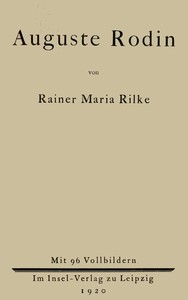
Auguste Rodin by Rainer Maria Rilke
Okay, let's be clear: this isn't a storybook with a plot. Rainer Maria Rilke's Auguste Rodin is a poet's love letter to a sculptor's work. Rilke, a young writer still finding his voice, spent time as Rodin's assistant. This book came from that experience. It's his attempt to put into words what he saw Rodin put into plaster, bronze, and marble.
The Story
There's no narrative in the usual sense. Instead, Rilke takes us on a tour of Rodin's world. He describes the chaotic studio, filled with fragments of bodies—a torso here, a clenched hand there. He walks us around famous works like The Thinker or The Burghers of Calais, not just telling us what they look like, but trying to explain the feeling they create. The 'story' is the story of an artist's process. Rilke shows us Rodin's belief that every surface, every curve, holds meaning. He writes about how Rodin would study ancient fragments and see complete stories in them. The conflict is quiet but constant: how can words, which are linear and abstract, ever truly capture something physical and immediate like a sculpture? Rilke wrestles with this on every page.
Why You Should Read It
You should read this if you've ever looked at a piece of art and felt something but couldn't explain why. Rilke gives you a new vocabulary for that feeling. He doesn't use dry art terms; he uses metaphor and raw emotion. When he describes a sculpture's surface, he might talk about it 'gathering light' or compare its tension to a drawn bowstring. It's less criticism and more translation. You get a double vision: you see Rodin's sculptures through Rilke's awe-struck eyes. It also becomes a book about Rilke himself, about a poet learning from a master the importance of relentless, daily work. It’s incredibly inspiring for anyone in a creative field.
Final Verdict
This book is perfect for art lovers, poets, and anyone curious about the creative spirit. It's not for readers who want a straightforward biography with all the facts and figures. It's short, dense, and demands your attention. Think of it as a meditation. If you're willing to slow down and sit with Rilke's intense observations, you'll come away seeing the world—and art—a little differently. It's a masterclass in looking closely, written by one of the great poets of the 20th century about one of its great sculptors. A unique and powerful little book.
This is a copyright-free edition. Distribute this work to help spread literacy.
Mason Gonzalez
1 year agoI started reading out of curiosity and the atmosphere created is totally immersive. Highly recommended.
Oliver Young
11 months agoCitation worthy content.

Patricia Sanchez
1 year agoIf you enjoy this genre, it creates a vivid world that you simply do not want to leave. Definitely a 5-star read.