
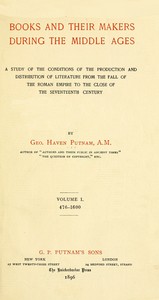
Books and their makers during the Middle Ages : A study of the conditions of…
Forget what you think you know about dusty old history. George Haven Putnam's book is a detective story about the most important object in Western civilization: the book itself. It asks a simple but huge question: How did books make it from the fall of Rome to the Renaissance?
The Story
This isn't a novel with a plot, but it has a clear journey. Putnam starts in the early Middle Ages, when books were rare, expensive, and copied by hand almost exclusively in monasteries. He shows us the scribe's world—the candlelit hours, the painstaking work, the occasional funny doodles in the margins. The story then follows the book out into the wider world. We meet the university scribes trying to keep up with student demand, the early booksellers, and finally, the revolutionary arrival of the printing press. The conflict is constant: against time, decay, war, and the sheer physical difficulty of making a book before modern technology.
Why You Should Read It
I loved this because it makes you appreciate the physical book in a new way. Putnam fills the narrative with incredible details that stick with you. You'll learn about the cost of parchment (a whole herd of sheep for one Bible!), the secret networks for trading texts, and how the job of a librarian was once a dangerous one. It connects big history to tiny, human acts of preservation. After reading it, I looked at my own bookshelf differently. Every book there is the winner of a thousand-year-long relay race, passed from hand to hand. It’s a powerful reminder of how fragile our connection to the past really is, and who we have to thank for it.
Final Verdict
Perfect for curious readers who love history, libraries, or a great story about how things work. It's for anyone who's ever picked up an old book and wondered about its journey. The writing is clear and engaging, though it's an older work so the style is formal in places. Don't expect a breezy novel—expect a deeply rewarding and eye-opening tour of the backstage of history, guided by a true enthusiast. If you're a fan of authors like Ross King or Stephen Greenblatt, who make art history thrilling, you'll find a similar spirit here.
The copyright for this book has expired, making it public property. It is now common property for all to enjoy.
Sarah Lopez
6 months agoThe clarity of the introduction set high expectations, and it manages to maintain a consistent flow even when discussing difficult topics. Definitely a five-star contribution to the field.
Daniel Wright
9 months agoI was skeptical at first, but the plot twists are genuinely surprising. I learned so much from this.
Kenneth Davis
5 months agoI started reading out of curiosity and it creates a vivid world that you simply do not want to leave. One of the best books I've read this year.
George Gonzalez
4 months agoI was skeptical at first, but the narrative structure is incredibly compelling. Don't hesitate to start reading.

John Davis
8 months agoThe methodology used in this work is academically sound.