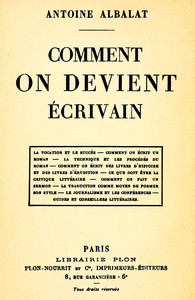
Comment on devient écrivain by Antoine Albalat
Published in 1925, Antoine Albalat's book isn't a novel with a plot. Think of it as a seasoned editor's notebook, filled with observations from a lifetime in French literature. Albalat was a critic and scholar who believed great writing could be studied and learned, not just magically received.
The Story
There's no traditional story. Instead, Albalat structures his book like a practical course. He walks you through the fundamentals: how to develop your style, the importance of rewriting (using Flaubert's famous agonizing over single sentences as a prime example), and how to observe the world like a writer. He fills the pages with examples, comparing early and final drafts of famous works to show the revision process in action. He talks about vocabulary, rhythm, and clarity, arguing against overly ornate or vague writing. The 'narrative' is the journey from a hopeful beginner to a competent craftsman, mapped out with advice that is sometimes surprisingly modern and other times charmingly of its time.
Why You Should Read It
What grabbed me was the sheer practicality of it. This isn't fluffy inspiration; it's a toolbox. Reading Albalat analyze a paragraph by Victor Hugo or dissect why a sentence by Chateaubriand works so well is like getting a private tutorial. It demystifies the process. You realize these literary giants weren't just born perfect—they worked, they edited, they doubted. His tone is direct and occasionally cranky (he has strong opinions about lazy metaphors!), which makes him feel like a real teacher. It’s reassuring. The book connects you to the timeless struggles and joys of writing.
Final Verdict
This is a must-read for aspiring writers who enjoy seeing the 'gears' of great literature. It's also a treat for serious readers who want to understand *how* a book achieves its effect. If you love peeking into the creative process, this historical guide is full of wisdom. Be warned: it's very focused on 19th-century French classics, so some references might require a quick Google. But the core lessons on hard work, observation, and revision are universal. Perfect for anyone who believes good writing is a craft you can learn, not just a talent you're born with.
This is a copyright-free edition. Enjoy reading and sharing without restrictions.
Nancy Thompson
9 months agoGreat value and very well written.
Susan Wilson
1 month agoComparing this to other titles in the same genre, the visual layout and supporting data make the reading experience very smooth. The price-to-value ratio here is simply unbeatable.
William Gonzalez
9 months agoThe peer-reviewed feel of this content gives me great confidence.
Linda Rodriguez
2 years agoGreat value and very well written.
Ashley Martinez
2 months agoI found the author's tone to be very professional yet accessible, the formatting on mobile devices is surprisingly crisp and clear. It cleared up a lot of the confusion I had previously.