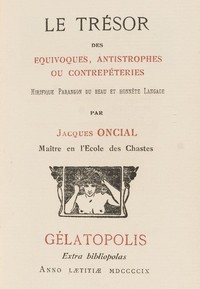
Le trésor des équivoques, antistrophes, ou contrepéteries by Léon Dupré-Carra
Let's be clear from the start: this isn't a novel. There's no protagonist, no rising action, and no climax in the traditional sense. 'Le trésor des équivoques' is a collection, an archive of linguistic accidents. Published in the late 19th century, it represents the life's work of Léon Dupré-Carra, a man seemingly obsessed with the moment language goes delightfully wrong. He scoured literature, conversation, and likely his own imagination to compile hundreds of examples of 'contrepèteries'—the elegant French term for spoonerisms.
The Story
There's no narrative story here. Instead, the 'story' is the journey of the language itself. Dupré-Carra acts as a curator, presenting these verbal flip-flops categorized and explained. One famous French example is switching the sounds in 'les trous du cul' to get 'les coups du truc.' The book is filled with these clever, often bawdy transformations. The 'conflict' is between the proper, intended meaning and the hilarious, unintended one that emerges when consonants and vowels swap places. Reading it feels like following a very polite, very learned man as he shows you his cabinet of curiosities, each drawer containing a perfectly preserved joke that's been hiding in plain sight within ordinary words.
Why You Should Read It
I loved this book because it completely changed how I listen. It’s a celebration of human error and creativity. Dupré-Carra wasn't just collecting jokes; he was treating these slips as a legitimate, fascinating part of how our minds work with language. It’s surprisingly insightful. You start to see the patterns, the mechanics of how a spoonerism works, and it gives you a weird kind of respect for the brain's speed and occasional clumsiness. It's also a huge amount of fun. There's a guilty pleasure in reading a proper, century-old text that is, at its heart, a compilation of sophisticated dad jokes and innuendos. It connects you to a sense of humor that's centuries old but feels instantly familiar.
Final Verdict
This book is a niche gem, but a brilliant one. It's perfect for word nerds, puzzle lovers, and anyone who enjoys the hidden mechanics of language. If you're studying French, it's a challenging and hilarious deep dive into phonetics and double meanings. History buffs might enjoy the window into 19th-century scholarly passions and humor. Just be warned: you need a decent grasp of French to truly appreciate it, as the magic is entirely in the wordplay. It’s not a page-turner; it’s a book to dip into, chuckle over, and marvel at the fact that someone thought this was important enough to write a whole book about. And you know what? He was right.
This book is widely considered to be in the public domain. It serves as a testament to our shared literary heritage.
Mary Taylor
1 year agoThe layout of the digital version made it easy to start immediately, the transition between theoretical knowledge and practical application is seamless. Finally, a source that prioritizes accuracy over hype.
Michael Garcia
4 months agoIt effectively synthesizes complex ideas into a coherent whole.
Michael Wilson
2 years agoMy first impression was quite positive because it addresses the common misconceptions in a very professional manner. I'm genuinely impressed by the quality of this digital edition.
Matthew Williams
1 month agoThis is an essential addition to any academic digital library.



Joseph Harris
1 month agoInitially, I was looking for a specific answer, but the inclusion of diverse viewpoints strengthens the overall narrative. It’s hard to find this much value in a single source these days.