1

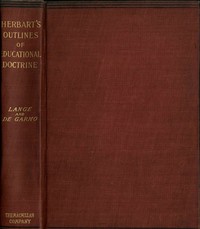
Outlines of Educational Doctrine — Context and Discussion
5
1
Project Gutenberg
2014
Education -- Philosophy
Readers of public-domain and historical texts
Project Gutenberg digital edition
en
Edition facts
Words: 82,848
Reading time: 361 min
Text sections: 13
Source:
Project Gutenberg record #44905
Herbart's final pedagogical work, translated with annotations by De Garmo, systematically links psychological theory to classroom practice, emphasizing apperception, interest, and moral training through concrete experience.
Editorial Edition Score
4.8/5
★★★★★
★★★★★
Calculated from edition completeness, EPUB availability, text structure and catalogue metadata. Not a user rating.
Edition quality
Herbart's Outlines of Educational Doctrine, here in the 1901 translation by Alexis F. Lange with annotations by Charles De Garmo, presents the philosopher's mature pedagogical system in numbered paragraphs. The work is distinguished by its insistence on a psychological foundation rooted in 'concrete experience' rather than rationalist abstraction. De Garmo's preface notes that Herbart's thought remains 'helpful in actual teaching' because it treats the mind as an 'apperceiving content' that educators can shape through controlled presentation of ideas.
Apperception and the Building of Mental Content
Herbart's core psychological concept, apperception, is the process by which new ideas are assimilated into existing mental structures. The excerpts show this operating at the level of moral development: the pupil learns to value objects not merely in monetary terms but through 'the inconvenience of doing without them.' This is not abstract moralizing but a practical mechanism for building judgment. De Garmo's annotations extend this to modern contexts, as when he discusses school savings banks as a device for teaching children 'the usefulness of saving' and inhibiting 'inordinate fondness for spending.' The theory thus grounds moral education in the gradual accumulation of experience, not in precepts.
The Teacher's Role in Shaping Ambition and Self-Esteem
Herbart warns against artificially fostering ambition, noting that those 'interested in the progress of a pupil' often become 'involuntary flatterers,' pushing the child beyond his actual capacity. The remedy lies in a careful calibration of praise and expectation. De Garmo's annotation on college athletics provides a concrete illustration: the 'abnormal overestimation of physical excellence' leads to a 'false estimate of values' that the teacher must counteract. This section reveals Herbart's sensitivity to the social pressures that distort education, and his insistence that the teacher's task is to build genuine self-esteem through accurate feedback, not to inflate hopes that lead to 'bitter experiences.'
Moral Education Through Practical Experience
Herbart treats moral faults such as parsimony and squandering as matters for 'moral education' when the pupil's 'own sense of honor' fails to correct them. The method is experiential: the pupil must 'gain experience on a small scale' with money and possessions. De Garmo's annotation sharpens this by noting that 'self-indulgence at the expense of those who have a natural right to an equitable share' is a form of selfishness that constant exposure will cure. The teacher's role is to 'unveil' such conduct, not through punishment but through consistent revelation of consequences. This approach aligns with Herbart's broader system, where moral training is inseparable from intellectual development and the gradual formation of character through controlled experience.
Readers will find that Herbart's numbered paragraphs reward sequential study, as each builds on the preceding. De Garmo's annotations, set in indented text, offer both historical context and practical applications, but the core argument remains Herbart's: education is a science of presenting ideas in such a way that they become the mind's own content. The excerpts here, though limited, demonstrate the systematic coherence that makes this work a key document in the history of pedagogical theory.
Reader reflection
How did this book work for you?
Your answers remain private and are stored only in this browser.
Your progress
0
/
10
2
Was reading this book enjoyable?
3
Is this a title you would suggest to others?
4
How demanding did the text feel?
5
How useful did the reading feel?
6
Did you relate to its people, ideas, or situations?
7
Which aspect of the book did you value most?
8
How would you rate its originality?
9
In one sentence, what did you learn?
10