
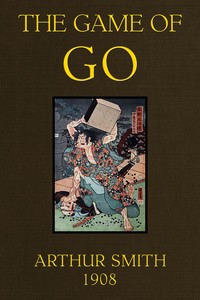
The Game of Go: The National Game of Japan by Arthur Smith
Arthur Smith's *The Game of Go: The National Game of Japan* isn't your usual how-to manual. It feels like stumbling onto a secret diary from 1908, where an American author is trying to share an obsession no one in the West yet understands. And boy, does it stick with you.
The Story
The book walks you through Go from scratch, with a smile. It explains that a simple 19x19 grid holds two players squabbling over stones? Nah—it holds the coiled potential of a thousand swords. Smith tells you the ground rules, basic shapes called “joseki”, and then the mental sparring of middle game fights. But the real story lurks behind the instructions. It's the stunning moment when you realize that every stone you place is a breath, part of a living argument across the board. Victories aren't loud here—they empty you, slowly drinking your opponent’s choices. And Smith praises Go’s age, its back alleys of skill, turning it from dried game into a subtle visit.
Why You Should Read It
First bloom of obsession: you can practically taste it. And Smith leaves no pretension dust: he feels he’s presenting art. Lines like “nothing less than the whole structure produced beforehand” and comparisons to eastern philosophies place humble moves in an ancient pond. As someone addicted to strategy, this felt nostalgic and jarring. I flinched when he said “mastering this step requires peaceful elimination of hurry.” Sound fluffy? But reading this now? In fast laptop flickering? Hits you deep. Go fans all apparently respect stone, but this book gives real context of why. The go amateur might just be hunting souls?
Final Verdict
Smash word?
It’s for the seeker of simple play that teems with infinitely complex decisions.
Perfect for history buffs, board gamers in heavy hunt of meaning, or any casual soldier just curious why Sun Tzu exists half as big picture duel of joy. But fair notice: this reads as devotional as a fan letter to heavy form. You won't finish it without at least trying to place even one ghost from Smith’s drawn example. His own plain passion echoes—half teacher, half captive. If you have the courage habit of feeling gradually puzzled and reverent over an honest board full ancient grains? Honestly, do yourself this present: read tiny part early. See price? Leave a stone pull-mark on sense.
This publication is available for unrestricted use. It is now common property for all to enjoy.
John Wilson
7 months agoIt took me a while to process the complex ideas here, but the narrative arc keeps the reader engaged while delivering factual content. Top-tier content that deserves more recognition.
Mary Hernandez
1 year agoI started reading this with a critical mind, the concise summaries at the end of each section are a lifesaver. I'll be recommending this to my students and colleagues alike.

Linda Moore
8 months agoIt effectively synthesizes complex ideas into a coherent whole.