
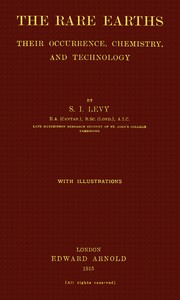
The Rare Earths: Their Occurrence, Chemistry, and Technology by Stanley Isaac Levy
The Story
Think of this book as a time machine straight into a chemist’s lab from 1900. Stanley Isaac Levy isn’t writing a dry science textbook—he’s a kind of explorer with a magnifying glass, trying to prove that these mysterious 'rare earths' (elements like lanthanum and gadolinium) aren’t just boring atoms. No, they can split light into brilliant colors, make steady high-intensity lamps, and later, power your phone screen. The plot boils down to ":how on Earth do we actually separate and use each rare-earth kind?” At that time, most scientists couldn’t even isolate pure samples, and all they knew was that deposits showed up weirdly: some in sunny Scandinavia, others in American rivers. Levy documents experiments, mistakes, and tiny victories—like getting a sliver of pure europium—so we can picture individuals pouring over crates, boiling minerals, and arguing over white pages of a notebook. The whole thing ends with a hopeful peek into what future industry might unlock. Simple premise, huge impact.
Why You Should Read It
Honestly, I sat down expecting sleet from 'older-than-time' jargon, but something else happened: I got this secret-society feeling while reading about tests for phosphor agents. Have you ever deciphered ancient recipes? This book treats technology like magic that wants to go mainstream. Every chapter comes across as a love letter to basic chemistry—separating one ion at a time, because that single atom makes LED signals possible. The fact the author uses house-friendly language and never brags about hero moves makes you root for the team of shy scientists.
One massive win is the sheer novelty—today this info is essential for gadget sellers, but 110 years ago? It was wild card alchemy now validated. As a re-reader, I also love shades of old practical wisdom; for instance, safety warnings are phrased bluntly: 'If the lanthanum metal ignites, do not splatter water, for the flare burns right through to the bone.' He warns so a rookie can live. How caring is that via long range? It leans on trust:
Final Verdict
Perfect for history-of-science nerds and anyone who grew up tearing apart radio parts to understand 'how.' If you love fact-based origin stories—not glosses, please—pick this up headfirst. Also unreal for tweakers: hobbyists working with solid-state circuits will grin identifying battle situations later solved thanks to manganese-rare miscourse chases. Kind of anticlimactic: surprising, strange, and utterly redemptive—just like a proper unspeakable element should be.
This title is part of the public domain archive. Distribute this work to help spread literacy.
Elizabeth Lopez
1 year agoI was skeptical about the depth of this book at first, but the author manages to bridge the gap between theory and practice effectively. Simple, effective, and authoritative – what else could you ask for?
Charles Martinez
4 months agoInitially, I was looking for a specific answer, but the level of detail in the second half of the book is truly impressive. Well worth the time invested in reading it.
Jennifer Lee
3 months agoComparing this to other titles in the same genre, the nuanced approach to the central theme was better than I expected. I'm genuinely impressed by the quality of this digital edition.
Charles Martin
6 months agoThis was exactly the kind of deep dive I was searching for, it addresses the common misconceptions in a very professional manner. This exceeded my expectations in almost every way.







James Wilson
11 months agoI was particularly interested in the case studies mentioned here, the author doesn't just scratch the surface but goes into meaningful detail. This is a solid reference for both beginners and experts.