
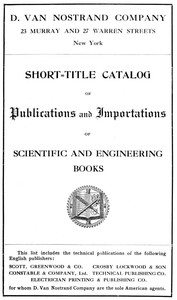
Short-Title Catalog of Publications and Importations of Scientific and…
Let's get the obvious out of the way: this is a catalog. A very old, very thick catalog from a publisher named D. Van Nostrand. It lists thousands of books, mostly textbooks and technical manuals, from the mid-to-late 1800s. There's no main character, unless you count the collective ambition of an era. There's no three-act structure, just columns of titles, authors, and prices.
The Story
The 'story' here is the explosive growth of specialized knowledge. Page after page, you see the building blocks of the modern world being organized and sold. One section is all civil engineering: how to build bridges, railroads, and sewers. Another is dedicated to the new science of electricity. There are manuals for pharmacy, for metallurgy, for navigation. It's the inventory of a society that's decided to understand and control its environment through science and machinery. The plot twist is realizing this isn't just a sales list; it's a map of intellectual priorities. What's missing is as telling as what's included. You see the practical, the applied, the mechanical. It's a record of a culture tooling up.
Why You Should Read It
You don't 'read' this book cover-to-cover. You explore it. I spent an hour just wandering through the medical section, seeing how diseases were understood (or misunderstood) back then. The dry titles hide profound dramas. A book on 'Sanitary Engineering' wasn't just about pipes; it was about fighting cholera. A manual on 'Steam Boilers' was about preventing catastrophic explosions in factories and ships. This catalog makes history tangible. It connects grand ideas—the Industrial Revolution, the rise of the expert—to the physical object someone would hold in their hands to learn a trade or invent something new. It’s unexpectedly humbling to see how much they wanted to know, and how hard they worked to spread that knowledge.
Final Verdict
This is a niche book, but a fascinating one. It's perfect for history buffs, especially those interested in the 19th century, the history of science, or the history of the book itself. It's also great for writers or world-builders looking for authentic period detail. If you're a casual reader looking for a narrative, this isn't it. But if you're the kind of person who loves digging through archives or getting lost in Wikipedia rabbit holes, this catalog is a primary source treasure trove. Think of it less as a book to read, and more as a museum exhibit you can browse from your armchair.
This is a copyright-free edition. Use this text in your own projects freely.
William Thompson
2 years agoA bit long but worth it.
Emma Garcia
1 year agoGreat reference material for my coursework.
Jessica Rodriguez
2 months agoI had low expectations initially, however it provides a comprehensive overview perfect for everyone. This story will stay with me.
Emma Thompson
1 year agoJust what I was looking for.




Jessica White
1 year agoI found the data interpretation to be highly professional and unbiased.