
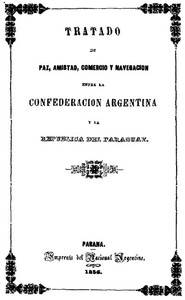
Tratado de Paz, Amistad, Comercio y navegacion entre la Confederación Argentina…
Let's be clear from the start: this isn't a book with characters and a plot in the traditional sense. It's a historical document, the Treaty of Peace, Friendship, Commerce and Navigation that formally ended the War of the Triple Alliance in 1870. But to understand its power, you have to know the story behind the signature.
The Story
The Paraguayan War was arguably the bloodiest conflict in Latin American history. For over five years, Paraguay fought alone against the combined forces of Argentina, Brazil, and Uruguay. The cost was almost unimaginable—some historians estimate up to 70% of Paraguay's adult male population was killed. By 1870, the nation was utterly devastated. This treaty is the final, formal act of that tragedy. Its articles methodically lay out the terms of Paraguay's surrender: establishing new borders that stripped away about 40% of its territory, dictating war reparations it could never hope to pay, and trying to set rules for a 'normal' future that must have felt impossible to the survivors. It's a document born from total exhaustion and defeat.
Why You Should Read It
You read this to feel history's weight. There's a chilling disconnect between the dry, legalistic language ('Article IV: Free navigation shall be permitted...') and the catastrophic reality it codifies. You won't find descriptions of battlefields or grieving families here. Instead, you find the consequences. The treaty is a map of loss. Every clause about borders is about land given up. Every article on debt is about a future mortgaged. Reading it, you're forced to read between the lines and imagine the silence in Asunción when the ink dried. It turns abstract concepts like 'defeat' and 'reconstruction' into something concrete and terribly sad. It’s a stark reminder that the official record often hides the deepest human wounds.
Final Verdict
This is not for casual readers looking for a narrative history. But if you're a history buff who wants to go beyond textbooks and get as close to the primary source as possible, it's fascinating. It's also powerful for anyone interested in diplomacy, the raw mechanics of ending a war, or the quiet language of power. Think of it as the foundational legal document for modern Paraguay, one written in the aftermath of a national trauma. Reading it is a sobering, unique way to connect with a pivotal moment that still echoes today.
This is a copyright-free edition. You are welcome to share this with anyone.
Linda Anderson
2 months agoSolid information without the usual fluff.
John Thompson
5 months agoThis was exactly the kind of deep dive I was searching for, the attention to detail regarding the core terminology is flawless. I feel much more confident in my knowledge after finishing this.
Donald Martinez
2 years agoIt’s rare to find such a well-structured narrative nowadays, the breakdown of complex theories into digestible segments is masterfully done. I'll be citing this in my upcoming project.
Sarah Miller
1 year agoHaving explored several resources on this, I find that the practical checklists included are a great touch for real-world use. It cleared up a lot of the confusion I had previously.


Mary Miller
2 weeks agoI've gone through the entire material twice now, and the way the author breaks down the core concepts is remarkably clear. Well worth the time invested in reading it.